

This article summarises patient-reported community survey data. It is educational and is not medical advice, and it is not a randomised controlled trial. The Vitamin D3 Anti-Inflammatory Regimen involves therapeutic doses of vitamin D3 and should be discussed with a qualified clinician and monitored with blood tests. Please read the blood-test and safety guidance before starting.
One of the most common questions people ask about the Vitamin D3 Anti-Inflammatory Regimen is simple: does it actually work, and for how many people? The honest answer is that the strongest evidence we have is not a big pharmaceutical trial. It is the community itself: hundreds of cluster headache patients who tracked their own outcomes and reported them.
Pete Batcheller, who developed and refined the regimen, ran a structured community survey to capture exactly that. This article shares what that data showed, keeps the claims conservative, and explains why we are now continuing the survey here on this site.
How the survey was run
The survey was a self-reported, self-funded, pre-post open-label outcome survey of cluster headache patients using the regimen. It began in December 2011 and ran for years, asking around 40 questions covering headache pattern, dosing, 25(OH)D blood levels before and after, time to response, side effects, and other treatments.
The central question it set out to test was whether there is an inverse relationship between cluster headache frequency and vitamin D3 status (as measured by the 25-hydroxyvitamin D, or 25(OH)D, blood test). The pre-set primary target was a response rate of at least 70% within 30 days.
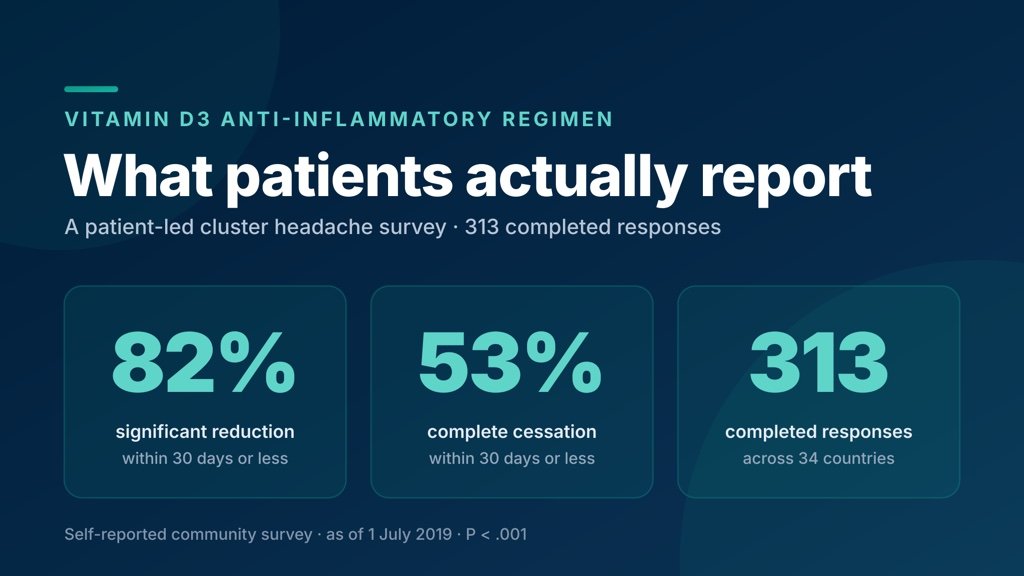
As of 1 July 2019, 602 cluster headache sufferers had started the survey and 313 had completed and submitted a full response.1
What the 313 completed responses showed
Among those who completed the survey, the reported outcomes were striking. These are patient-reported figures, not trial endpoints, but the pattern is consistent and the numbers are large enough to be meaningful.
- 82% reported a significant reduction in the frequency, intensity, or duration of their cluster headaches within 30 days or less, an average shift from roughly 3 attacks per day to 3 attacks per week.1
- 53% reported complete cessation of their cluster headaches within 30 days or less.1
- The reported effect reached statistical significance in the survey analysis (P < .001), with a number-needed-to-treat of about 3.1
Who were these respondents? The demographics were broadly what you would expect of a cluster headache population: about 77% male, about 72% episodic (the rest chronic), a mean age of 45 years, a mean of 17 years living with cluster headache, and participants from 34 countries.1
A word of caution here, in the spirit of honesty. Episodic cluster headache comes in bouts that end on their own, so some episodic responders may have improved partly because their cycle was ending anyway. Pete flagged this confounding factor directly. It is one reason the community keeps collecting data rather than declaring the question settled.
Why some people did not respond
Roughly 19% did not respond to the regimen, and the survey work pointed to a consistent explanation: competing inflammation. Other inflammatory demands, such as allergies, infections, recent trauma or surgery, or autoimmune conditions, can draw down vitamin D3 and 25(OH)D, leaving too little to support the genetic activity linked to preventing attacks. The other common reason was simply a dose that was too low, leaving 25(OH)D below the level needed.1
This is why the regimen is not just "take some vitamin D." It is a monitored approach: test 25(OH)D, calcium and PTH, titrate the dose, and address competing inflammation.
The antihistamine clue
One of the most interesting threads in the data, and one that still comes up in responses today, is the role of a first-generation antihistamine such as diphenhydramine for people who stall. The proposed mechanism is specific: an allergen triggers mast cells to release histamine; histamine acting on H1 receptors can up-regulate CGRP (calcitonin gene-related peptide) and substance P, which drive the pain signalling of an attack. Blocking those H1 receptors is thought to down-regulate that cascade.1 CGRP's involvement in cluster headache is independently well established, and infusing CGRP can provoke attacks in susceptible people.2
Some patients report that adding diphenhydramine to the regimen was the point at which their attacks finally broke. It is a reminder that cluster headache is rarely one-dimensional, and that the "full picture" often matters more than any single ingredient. As always, adding any medication is a conversation to have with your own doctor.
How this fits with the biology
The proposed mechanism of the regimen is not that vitamin D3 is a painkiller. It is that therapeutic vitamin D3 status enables genetic expression that down-regulates the messengers involved in cluster and migraine pain: CGRP, substance P, VIP and PACAP. A widely cited analysis found the vitamin D receptor occupies thousands of positions across the genome and that hundreds of genes change expression in response to vitamin D3.1 The exact mechanism in cluster headache remains unconfirmed and needs formal study, but the biological plausibility is real, and low vitamin D status has been reported in cluster headache patients.3
Keeping it safe
None of this removes the need for care. Vitamin D3 at therapeutic doses is powerful, and status is assessed with the serum 25(OH)D test; excessive intake can raise calcium and cause harm.4 That is why this site keeps returning to the same message: work with your clinician, get your baseline and follow-up blood tests, and treat the regimen as a monitored plan, not a set-and-forget supplement. Contra-indications such as hyperparathyroidism and sarcoidosis matter, and acute attacks still deserve proven treatments such as high-flow oxygen.
We are still collecting this data, so please add yours
Pete's survey built the picture we have today. We are now continuing that work with a refreshed survey on this site, so the community's real-world experience keeps growing and stays current. Whether the regimen transformed things for you, helped a little, or did not work at all, your response matters. The honest "no" data is every bit as valuable as the "yes."
References
- Batcheller P. Controlling Cluster Headache Safely, Effectively and Inexpensively: the Vitamin D3 Anti-Inflammatory Regimen community survey (2011 to present). Results as of 1 July 2019 (313 completed responses); an earlier abstract of this patient-reported survey was submitted and presented at the American Academy of Neurology Annual Meeting, 2014. Self-reported, self-funded, pre-post open-label outcome survey.
- Vollesen ALH, Snoer A, Beske RP, et al. Effect of infusion of calcitonin gene-related peptide on cluster headache attacks: a randomized clinical trial. JAMA Neurology. 2018;75(10):1187-1197. doi:10.1001/jamaneurol.2018.1675
- Sohn JH, Chu MK, Park KY, Ahn HY, Cho SJ. Vitamin D deficiency in patients with cluster headache: a preliminary study. The Journal of Headache and Pain. 2018;19:54. doi:10.1186/s10194-018-0886-7
- National Institutes of Health Office of Dietary Supplements. Vitamin D: Fact Sheet for Health Professionals. NIH ODS fact sheet
Leave a Comment